
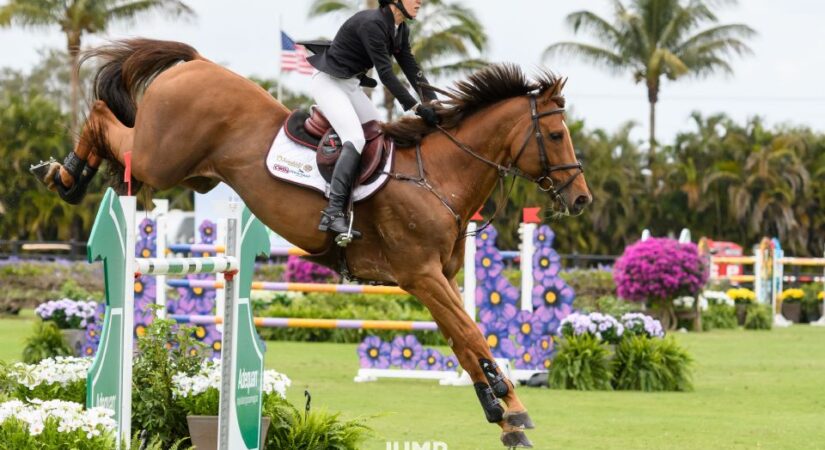
Competitive jumping grew out of foxhunting, which involved riding across open countryside and jumping ditches, banks, walls and fences—whatever stood in the way. Well into the 1960s and 1970s, that heritage remained plainly evident in the competition arena.
For generations, most jumper and hunter horse shows in the United States were held on wide-open grass fields with undulating terrain. Ocala, Palm Beach, Ox Ridge, Lake Placid, Saratoga, Chagrin Valley, Monmouth, Southampton, and more were all held on grass before those grounds became the year-round industrial circuit.
Outdoor courses in wide-open fields with natural obstacles were once routine in hunter competition. The only real exceptions were the indoor fall shows—Harrisburg, Washington, New York and Toronto—where grass was never an option. Even Devon, now noted for its synthetic all-weather ring, held competition on turf for more than a century before making the switch.
That world of wide-open grass competitions is gone, replaced by a sanitized, ring-bound aesthetic. Very few of today’s hunter or jumper riders are ever required to navigate a course without a fenced-in arena to define it, where there are no lines to ride and no stride numbers to count, just galloping and jumping across open ground with varied terrain.
And it is not only about the absence of lines. Anyone who has foxhunted knows that riding on grass requires an understanding of footing that today’s synthetic, all-weather surfaces do not. There is a speed limit on grass. Turns must be ridden in balance, with the horse’s weight off the forehand.
When competing on grass was still routine, some days the ground was wet, some days hard, and you changed your shoeing and adjusted how you tackled the jumps accordingly. Today’s all-weather footing is engineered for consistency, which is exactly why it won the commercial argument. Riders can ride more aggressively, more often, with less weather fluctuation. That is the honest reason synthetics took over, and it is a real one.
Only a minority of the industrial calendar still runs on grass, but those fixtures remain the sport’s showcases. Aachen and Hamburg in Germany, Spruce Meadows in Canada, Britain’s Hickstead, La Baule and Dinard in France, Falsterbo in Sweden, Dublin in Ireland, and Rome’s Piazza di Siena, which returned to turf a decade ago, are prime examples.
These long-standing, somewhat anachronistic events showcase the sport in a way no synthetic ring can. It is the same reason people stop to watch golf on television for the green vista or find something inherently beautiful in a polo match on real turf. Grass is not incidental to those sports’ appeal. It is integral to that appeal.
These venues are not holding onto grass out of nostalgia alone. In 2010, Hickstead spent roughly $675,000 to rebuild its main International Arena specifically to keep it on turf, even as it converted a secondary ring to synthetic footing for scheduling flexibility. It does not have to be either/or.
A Hybrid Approach
An example of that is the Del Mar Horsepark in California, where its centerpiece Grand Prix field has been intentionally preserved as a premium, world-class grass ring. The facility uses synthetic footing in its other rings and warm-up areas, illustrating a hybrid approach. But keeping grass requires better riding and a return to the sport’s origins—literally to its grass roots.
In Wellington, Florida, a grass derby field has been completed at the newly expanded Winter Equestrian Festival site. Richard Hayden of Hayden Turfcare, the same specialist behind Hickstead and Dublin’s turf arenas, built it as the first self-attenuating grass arena in Wellington, designed to hold water in an underground layer and release it slowly, which matters in a place where it rains and floods. The facility’s main ring remains synthetic, but meticulous attention to detail and multiple underground layers—and a lot of money—went into the seemingly innocuous grass derby field. It is, in fact, a staggeringly high-tech surface. A solid root base is currently being grown ahead of the 2027 season, and I cannot wait to see it brought into full competitive use.
This fancy turf, suitable for elite-level competition, may be out of reach for most. But basic, well-maintained grass, which retains its natural cushioning effect, is eminently suitable for lower- and mid-level competition.
Given the commercial pressures on today’s horse show organizers, it is understandable that synthetic surfaces have taken over. They allow thousands more horses to jump without compromising the footing. It is the same reason tennis schools and clubs use asphalt courts instead of grass. A synthetic ring can handle effectively unlimited traffic. However, that does not mean it is best for the horse, the rider or the spectator.
The Hampton Classic learned this the hard way. After a $1million renovation of its main grass Grand Prix field in 2018, the surface performed well in 2019, but by 2021 it was no longer holding up. By 2022, the show had abandoned its decades-long tradition in favor of all-weather footing. In another example of a functional hybrid approach, it still maintains several grass auxiliary rings.
Think back to the days of the American Invitational, held for more than 40 years on the grass field inside Tampa Stadium, the only long-running grand prix staged inside an NFL stadium, or to the Chagrin Valley Grand Prix, the Charlotte Grand Prix, and the Valley Forge Grand Prix in the 1970s and 1980s. These were stand-alone jumping competitions held in large outdoor stadiums and fields, with few or no on-site warm-up classes. They were genuine entertainment events built for the public and drew the sport’s highest-caliber horses and riders. They no longer exist. I doubt whether today’s top riders—or the FEI—would even agree to a stand-alone grand prix like that anymore, no matter the prize money.
A Chance to Thrive Again
Given how much it now costs to compete, one wonders whether there should be a return to the grass-field local horse show, which is less costly, perhaps something run outside full U.S. Equestrian Federation rules, or under a lighter version of them. It might not attract elite trainers and their clients, but plenty of local riders and competitors would go. Is there a way to bring back the one- or two-day horse show without spending hundreds of thousands of dollars on footing and amenities? That kind of show deserves a chance to thrive again.
The United Dressage and Jumping Club is an innovative example of how to address some of the barriers to showing, namely USEF’s fees, show managers’ charges and competitors’ expectations for flawless footing. The UDJC’s mission to make equestrian sports more accessible, fair and enjoyable for everyone deserves applause and support.
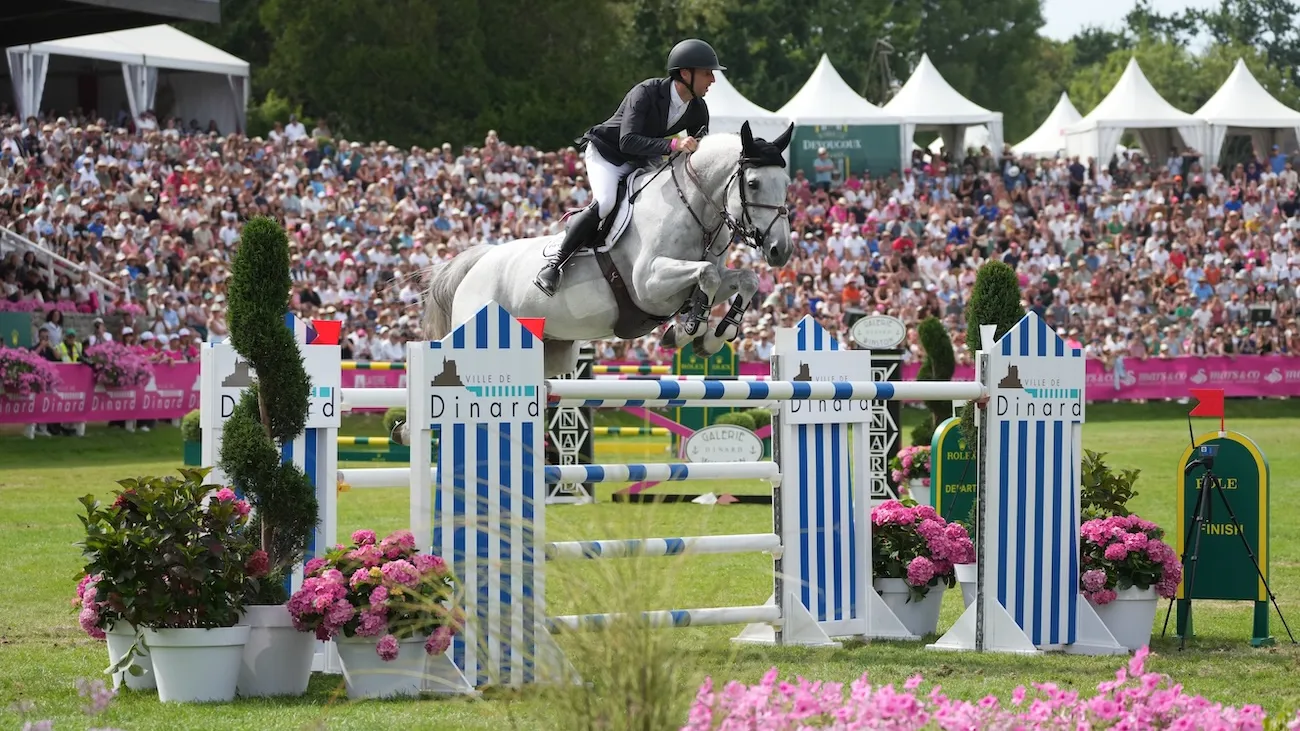
© Sportfot
Evolved To Perform On Grass
There is another side to this, too, and it is about the horse. Over thousands of years, horses’ limbs, hooves, and musculature evolved to perform on grass. Biomechanically, they are built to function on turf. Unlike human athletes, horses have no say in the surfaces on which they perform.
In the soccer world, FIFA’s regulations require natural grass at the World Cup for exactly this reason. Turf gives, absorbs and cushions impact. Synthetic footing does not give in the same way, and the joints take the brunt of the difference. The FIFA World Cup 2026 forced grass into multiple NFL stadiums that normally house an artificial pitch, and NFL players responded with a campaign under the hashtag #WorthTheCost. They argued that if stadium owners can make grass work for the World Cup, they can make it work for football, adding, “…we prefer grass fields. We know it’s better on our bodies.” That is a clearer, more current argument than debating what the NFL players agreed to in their collective bargaining agreement.
Riders and veterinarians who have lived with both surfaces report different wear patterns, with more chronic joint and soft-tissue fatigue on hard, unforgiving synthetics, even though controlled studies have not produced a clear outcome. Research from the University of California, Davis on jumping surfaces found that maintenance, depth and consistency predict stress better than the basic labels of grass versus synthetic.
The honest welfare claim is not that grass is magic. It is that competition surfaces that never give—used repeatedly, week in and week out—change the injury mix. I understand why the day-to-day industrial horse show complex, built to handle huge numbers of entries, cannot run on grass. But that does not mean it should be abandoned altogether. Grass is better for the horse, better for the spectator and better for television. Aachen’s luscious emerald-green main arena looked glorious during the 2026 FEI World Championships, when Steve Guerdat and Dynamix de Belheme won individual gold with five clear rounds, surrounded by 40,000 spectators.
The Real Grassroots Crisis
When a private-equity-funded show series folds, no network of one- and two-day weekend shows remain to fill the gap. That is the real crisis at the grassroots level. The sport has been consolidated upward into larger, more expensive events, and the local lattice beneath has thinned out.
We need competitions where you can drive up with your trailer or van, set up some folding chairs, and enjoy a nice day of competition before heading home for dinner. Maybe it is time to return to the low-key horse show that tops out at 200 horses. Somewhere where you can pull in, roll up your sleeves, get a little mud on your boots, and show your horse, just like we used to. Back to the grass roots.