
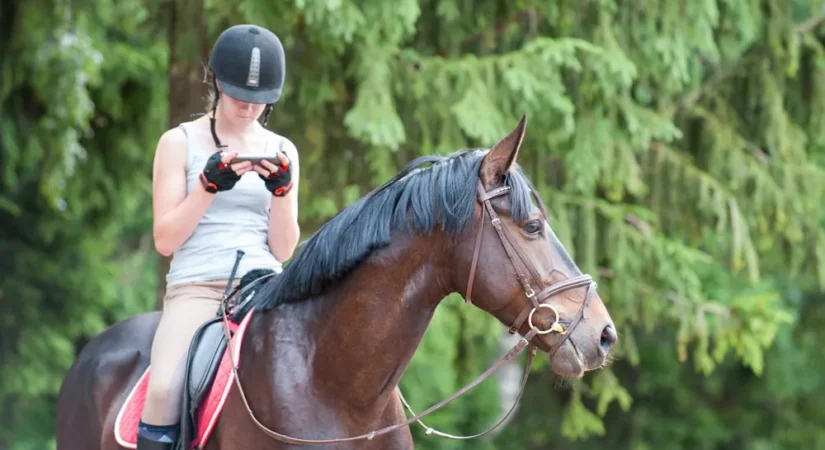
At a recent show, I noticed that many riders in the warm-up ring were paying more attention to their phones than to their horses.
Smart phones have become an unavoidable part of modern life. Many people spend hours each day on their phones. Leaving aside the broader social and psychological impacts, there is one place where cell phones simply do not belong: the competition schooling ring.
Talking on or looking at a cell phone while riding a horse in a competition schooling area creates a substantial and unnecessary risk of injury to other riders and horses. Distracted riding is every bit as dangerous in a crowded warm-up ring as distracted driving is on a busy highway. Equestrian
Riding a horse requires attention, awareness and communication. A horse constantly responds to the rider’s body language, balance and focus. As prey animals, horses continuously assess their surroundings and react to potential threats. Riders owe their horses the same level of attentiveness. Good horsemanship requires being mentally present and engaged with the horse.
Many riders, including experienced professionals, seem to believe they can ride safely while talking on a phone or glancing at a screen. Some probably can. But that misses the point. The issue is not whether a rider can stay mounted while using a phone. The issue is whether that rider’s distraction puts others at risk.
If someone wants to use a phone while walking back to the barn or riding around the show grounds, the primary risk is to the individual. The risk calculation changes significantly in a schooling ring, where multiple horses and riders work in close proximity.
Like pilots operating in controlled airspace or captains navigating a crowded harbor, riders in a warm-up ring must maintain constant situational awareness. They need to know where other horses are, how fast they are moving, which direction they are traveling, how they are behaving, and what lines they are likely to take through turns and around jumps. Riders must continually anticipate traffic patterns and maintain safe distances from others. EducationalResources
Anyone who regularly rides in busy schooling areas understands how important this is. Horses pass one another at speed. Riders circle, change direction, approach fences and merge into traffic patterns. Young or less experienced horses may spook, become distracted, or react unpredictably. Avoiding accidents requires every rider to remain constantly aware of what is happening around them.
That level of awareness cannot be sustained while reading text messages, scrolling through social media, checking emails or talking on the phone. A rider looking at a screen is not watching the horse approaching from the opposite direction. A rider engaged in a phone conversation is focusing their attention on someone who is not even in the ring.
As someone who regularly rides young horses, I do not want to round a corner in a crowded schooling ring and encounter riders whose attention is on their phones rather than on their horses and the horses around them. Fortunately, many attentive riders compensate for others’ inattentiveness. Unfortunately, that is not a sustainable safety strategy.
The U.S. Equestrian Federation has acknowledged the potential issue, but its current rule, which bans the use of earbuds and “the unsafe use of electronic devices, as determined by the competition steward in their sole discretion,” does not go far enough. Equestrian
While well-intentioned, the rule leaves enforcement largely to the subjective judgment of individual stewards. More importantly, it creates a curious inconsistency.
USEF has already concluded that earbuds and earphones pose an unacceptable safety risk in schooling and exercise areas. The reason is straightforward. Riders must remain aware of their surroundings. A rider who cannot hear approaching horses, warnings from trainers, or instructions from ring personnel presents a safety risk to everyone around them. That’s why earbuds are prohibited outright.
Yet the same reasoning applies even more strongly to holding and using cell phones while riding. A rider staring at a phone screen is not watching for a horse approaching from the opposite direction. A rider reading a text message is not assessing the traffic patterns of other riders and horses. A rider engaged in a phone conversation is devoting attention to something other than their horse and the environment immediately around them. That is how accidents happen.
If situational awareness is the safety principle that justifies a complete ban on earbuds, it is difficult to understand why active cell phone use is not similarly banned.
In many respects, looking at a phone is even more dangerous than wearing earbuds. At least a rider wearing earbuds can still see what is happening around them. A rider looking down at a screen is literally taking their eyes off the horse, the traffic and the environment. Horses
The current rule therefore prohibits one distraction outright while leaving the other to the discretion of individual stewards. That distinction is difficult to justify from a safety standpoint and would be even more difficult to defend after a serious accident.
The liability implications can’t be ignored. Accidents involving distracted riders are entirely foreseeable. Riders using cell phones in schooling areas are hardly rare; they’re seen at horse shows every week. When riders are routinely observed using phones in crowded warm-up rings, and no clear prohibition exists, the question inevitably arises whether reasonable steps were taken to protect participants from a known, preventable hazard, making it easier to argue liability.
The solution is straightforward: cell phone use while mounted in designated schooling and warm-up areas should be banned without exception, as earbuds are. The rule should be clear, objective, and uniformly enforced. Riders can dismount to make a call, send a text, or conduct business. There is no legitimate reason that cannot wait a few minutes until they are out of the saddle.
The warm-up ring is not the place to check messages, browse social media, conduct business, or take phone calls. It is a place where riders must give their full attention to their horses and to the safety of everyone around them.
Good horsemanship demands it. Common sense requires it. Safety depends on it. It is time to eliminate distracted riding before a preventable tragedy forces action.